Rank Math SEO Review
Choosing an SEO plugin for WordPress can be harder than it sounds. There are several options available, and most promise to make SEO easier. But which one gives you the tools you actually need without making your website more complicated?
Rank Math SEO is one of the WordPress plugins worth considering. It brings together several SEO tools, including on-page optimization, XML sitemaps, schema markup, and other features designed to help website owners manage their search engine optimization.
But is Rank Math a good choice for beginners? Is the free version enough for a small website? And is upgrading to Rank Math Pro worth the money?
In this Rank Math SEO review for 2026, we will look at its main features, advantages, limitations, free and paid plans, and how it compares with other SEO plugins. The goal is to help you decide whether it fits your website and your SEO workflow.
What Is Rank Math SEO?
Rank Math SEO is a WordPress plugin designed to help website owners manage important SEO tasks without having to handle everything manually.
It provides tools for optimizing page titles, meta descriptions, content, URLs, structured data, and XML sitemaps. Depending on the selected plan and configuration, users can also access additional tools for redirects, 404 monitoring, analytics, and other SEO-related tasks.
For someone running a blog, business website, or affiliate review site, having these tools in one place can make routine SEO work easier to organize.
However, installing an SEO plugin is only one part of the process. Helpful content, a technically sound website, relevant internal links, and a good user experience still matter. Rank Math can help with optimization, but it cannot guarantee higher Google rankings.

Rank Math SEO Review: Key Features
1. On-Page SEO Analysis
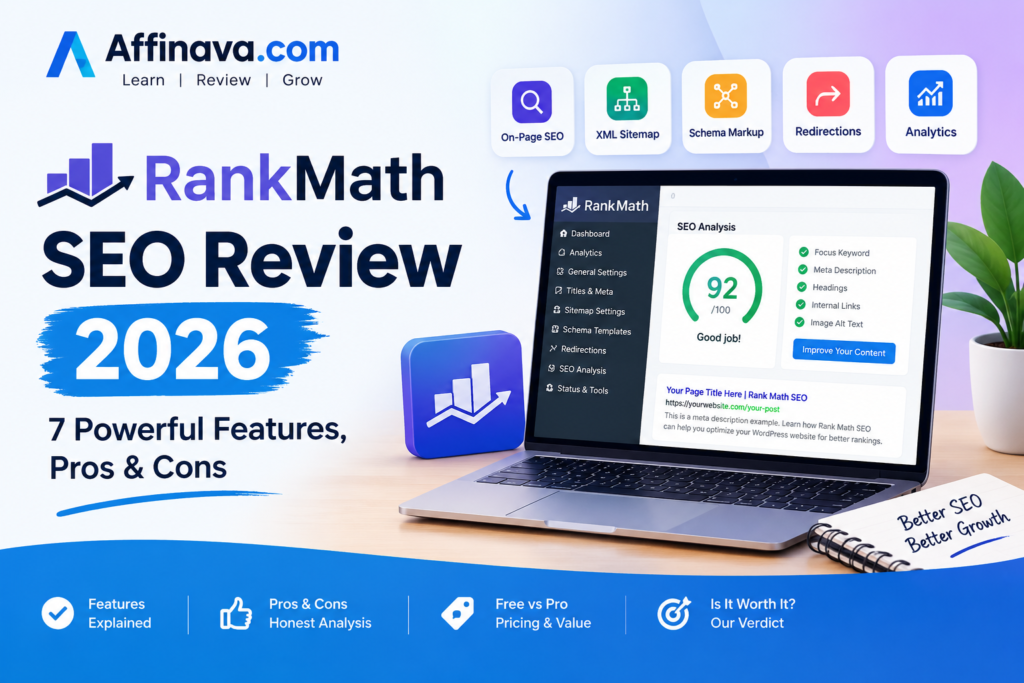
One of Rank Math’s main attractions is its on-page SEO analysis. The plugin checks different elements of a page and offers suggestions that may help improve optimization.
These checks can cover areas such as the focus keyword, title, meta description, headings, internal links, and other content-related signals.
For example, if you are writing a software review, you can use the suggestions to check whether your main keyword appears naturally in important places and whether your page includes useful internal links.
Still, it is important to understand what an SEO score means. A high score does not automatically make an article helpful, accurate, or capable of ranking well. Use the recommendations as a checklist rather than treating every suggestion as a rule.
2. SEO Titles and Meta Descriptions
Your page title and meta description help search engines and potential visitors understand what a page is about.
Rank Math provides tools to edit these elements and preview how your page may appear in search results.
For an affiliate review website, this can be particularly useful. Instead of using a vague title, you can write something more descriptive, such as:
Rank Math SEO Review 2026: Features, Pros, Cons & Pricing
The important thing is to make the title clear and relevant to the content. Avoid repeating keywords simply to satisfy a plugin score.
Google may also generate a different title link or snippet depending on the search query and page content, so your settings do not guarantee that the exact text will appear in search results.
3. XML Sitemap Generation
An XML sitemap helps search engines discover important URLs on your website.
Rank Math can generate and manage XML sitemaps, reducing the need to create them manually. This can be helpful when you publish new blog posts, update existing pages, or organize a growing website.
However, a sitemap does not guarantee that every submitted page will be indexed. Search engines still decide which pages to crawl and index.
You should also check your sitemap configuration to avoid unnecessarily including pages that should not appear in search results.
4. Schema Markup
Schema markup provides structured information about a page. Depending on the content, this can help search engines understand whether a page represents an article, product, organization, or another supported type of content.
Rank Math includes schema-related tools that can help website owners configure structured data.
For example, a software review may benefit from appropriate review-related structured data when it meets Google’s requirements.
But adding schema does not guarantee rich results. The markup must be accurate, follow the relevant guidelines, and match the visible content on the page.
5. Redirections and 404 Monitoring
Changing a URL can create problems if the old address is still receiving visits or backlinks.
Redirect tools can help send visitors and search engines from an old URL to a relevant new destination. A 404 monitor can also help identify URLs that return a page-not-found error.
These tools can be useful when restructuring a website or updating older articles.
That said, not every 404 error needs a redirect. If a page was intentionally removed and has no suitable replacement, redirecting it to an unrelated page may create a poor user experience.
Check the actual problem before making changes.
6. Google Search Console and Analytics-Related Tools
Rank Math offers integration options for accessing certain SEO-related information from supported services, depending on the configuration and plan.
These tools can help website owners understand aspects of their search performance and identify areas that may need attention.
For example, Search Console data can help you find pages receiving impressions but relatively few clicks. You can then review whether the page title accurately communicates the content’s value.
For reliable analysis, make sure the correct website property and account permissions are configured.
Rank Math SEO Review: Free vs. Pro
One question many website owners ask is whether they need the paid version.
The free version provides a range of useful SEO features. Depending on your website and requirements, it may be enough to handle routine optimization tasks.
Rank Math Pro adds more advanced capabilities, but the exact features and limits depend on the current plan.
| Area | Free version | Pro version |
|---|---|---|
| Basic on-page SEO | Available | Available |
| SEO titles and meta descriptions | Available | Available |
| XML sitemap tools | Available | Available |
| Basic schema capabilities | Available | Additional capabilities |
| Advanced SEO features | More limited | Expanded options |
| Best suited for | Basic SEO needs | Users needing additional tools |
This table is a general overview, not a complete feature-by-feature comparison. Check the official Rank Math pricing and feature pages before purchasing, because inclusions and plan limits may change.
For a new blog or a small affiliate website, starting with the free version is a reasonable approach. You can consider Pro later if you identify a specific feature that would save time or support a genuine business need.
Rank Math SEO Review:
Rank Math SEO Plugin Pricing

Note: This price can be changed. It depends on Rank Math.
Rank Math SEO Review:
Rank Math AI Pricing

Note: This price can be changed. It depends on Rank Math.
Rank Math SEO Review: Pros and Cons
Every plugin has strengths and limitations. Rank Math is no exception.
Pros
1. Several SEO tools in one plugin
Rank Math brings many common SEO tasks together, which can reduce the need to install separate plugins for every individual function.
2. Helpful optimization suggestions
Its on-page checks can remind writers to review titles, descriptions, headings, and other SEO elements before publishing.
3. Useful for growing websites
As a website gains more posts and pages, sitemap management, structured data, and URL-related tools can become increasingly valuable.
4. Free features to get started
Users can explore a number of important SEO capabilities without immediately purchasing a paid plan.
5. Flexible configuration
Users can configure supported features according to their needs rather than necessarily using every available module.
Cons
1. The interface may feel overwhelming.
Beginners may find the number of settings and available features confusing at first. Learning which options actually matter can take time.
2. Not every feature is free.
Some advanced tools require a paid plan or may have separate requirements. Check the current feature list before deciding which plan you need.
3. SEO scores can be misleading.
It is easy to focus too much on achieving a perfect score. A naturally written, useful article is more valuable than awkward content created merely to satisfy plugin checks.
4. Configuration still matters.
Incorrect settings can cause unnecessary indexing problems, duplicate metadata, or other technical issues. Installing the plugin does not remove the need to understand basic SEO.
Rank Math vs. Yoast SEO
Rank Math and Yoast SEO are both established options for WordPress users. The right choice depends on your preferred workflow and the features you need.
| Comparison | Rank Math | Yoast SEO |
|---|---|---|
| Main purpose | WordPress SEO management | WordPress SEO management |
| Content optimization | SEO analysis and suggestions | SEO analysis and suggestions |
| Free version | Offers a range of SEO tools | Offers a range of SEO tools |
| Advanced features | Depends on plan and configuration | Depends on plan and configuration |
| Learning experience | May require exploring several settings | Also requires learning its workflow |
| Best choice | Depends on your needs | Depends on your needs |
Rather than choosing based on a feature count alone, compare the specific tools you will use, the interface you find easier to understand, and the cost of any paid features you require.
If you already use one plugin and your website is working properly, switching solely because another plugin has a higher SEO score may not be worthwhile. Before migrating, plan the change carefully to avoid losing settings or creating duplicate metadata.
Is Rank Math SEO Good for Affiliate Websites?
Affiliate websites often publish reviews, comparisons, tutorials, and buying guides. These pages need clear titles, descriptive metadata, useful internal links, and appropriate structured data where applicable.
Rank Math can help manage several of these tasks.
For example, an affiliate review of a software product might use a descriptive SEO title, a relevant meta description, links to related reviews, and suitable structured data where supported and appropriate.
However, a plugin cannot make a thin review useful on its own. Readers still need honest explanations of the product’s strengths, limitations, pricing, alternatives, and intended audience.
Affiliate links should also be disclosed clearly, and recommendations should be based on accurate information rather than commission rates.
For a small affiliate website, the free version may provide enough tools to begin. More advanced features should be evaluated according to actual needs rather than purchased simply because they are available.
Who Should Use Rank Math SEO?
Rank Math may be worth considering for several types of WordPress users.
New bloggers: It can provide a structured way to learn common on-page SEO practices while publishing articles.
Affiliate marketers: It offers tools that can help organize metadata, internal links, sitemaps, and other SEO tasks across review pages.
Small business websites: Owners can use SEO settings to make important service and information pages easier to manage.
Experienced WordPress users: People managing multiple content types or more advanced SEO workflows may appreciate having several tools available in one plugin.
On the other hand, users who prefer a minimal setup or need only a few basic SEO functions may not need every feature Rank Math offers.
How to Get Started with Rank Math SEO
If you decide to try Rank Math, take a careful approach to the initial setup.
- Back up your website. This is particularly important if you already have another SEO plugin installed.
- Install the plugin from the official WordPress plugin directory. Avoid downloading unofficial copies.
- Follow the setup wizard. Review each setting instead of accepting every option without understanding it.
- Check your SEO titles and meta descriptions. Start with your most important pages.
- Review sitemap and indexing settings. Make sure the pages you want search engines to discover are configured appropriately.
- Test important URLs. Check for unwanted noindex settings, broken links, and unexpected redirects.
- Monitor performance over time. Use Google Search Console to review impressions, clicks, and indexing information.
If another SEO plugin is already active, follow a migration process and verify the resulting settings. Running overlapping SEO functions without proper configuration can cause conflicts or duplicate output.
If you are interested to our more review like SendFox Review, Enfold WP Theme, ThemeForest, please hit the button below.
Is Rank Math SEO Worth It in 2026?
Rank Math SEO is worth considering if you want a collection of WordPress SEO tools in one place and are comfortable spending some time learning the settings.
Its free version can be a practical starting point for bloggers and small website owners. The Pro version may be useful when its additional features address specific needs that the free version cannot meet.
However, there is no universal reason for every website to upgrade. Your decision should depend on your workflow, technical requirements, budget, and the value you expect to receive from the additional tools.
For a growing website, the best approach is to establish sound SEO fundamentals first: publish useful content, structure pages clearly, build relevant internal links, and monitor search performance. An SEO plugin can support that work, but it cannot replace it.
Rank Math SEO Review: Final verdict
Rank Math SEO is a WordPress SEO plugin worth evaluating, especially if you want to manage several common SEO tasks through one interface. Start with the free version if it meets your needs, and consider Pro only when you have a clear reason to upgrade.
Rank Math SEO Review: FAQs
Is Rank Math SEO free?
Yes. Rank Math offers a free version with a range of SEO tools. Paid plans provide additional capabilities, depending on the current plan.
Is Rank Math better than Yoast SEO?
Neither plugin is automatically better for every website. Compare their current features, ease of use, pricing, and compatibility with your workflow before choosing.
Does Rank Math guarantee higher Google rankings?
No. Rank Math can help with SEO configuration and optimization, but search rankings depend on many factors, including content quality, competition, technical performance, and search intent.
Is Rank Math suitable for beginners?
It can be suitable for beginners, although some settings may take time to understand. Start with the essential options and avoid changing advanced settings without a clear reason.
Should I buy Rank Math Pro?
Not necessarily. The free version may be sufficient for many smaller websites. Upgrade only if a Pro feature solves a problem you actually have.
Can I use Rank Math on an affiliate website?
Yes, it can be used to manage SEO tasks on an affiliate website. You should still provide helpful, accurate reviews, disclose affiliate relationships, and follow relevant search engine guidelines.
Affiliate Disclosure: This article may contain affiliate links. If you purchase through an eligible link, we may earn a commission at no additional cost to you. We aim to provide useful and honest information to help readers make informed decisions.
If you are interested to our more review like SendFox Review, Enfold WP Theme, ThemeForest, please hit the button below.